AJ133 · 508PS
AJ133 5.0Supercharged V8
A large V8, a belt-driven supercharger and instant response: the AJ133 gives Jaguar performance cars and Land Rover SUVs their familiar effortless pull. This guide covers the supercharged 508PS versions, whose hardware and output vary substantially across model years.
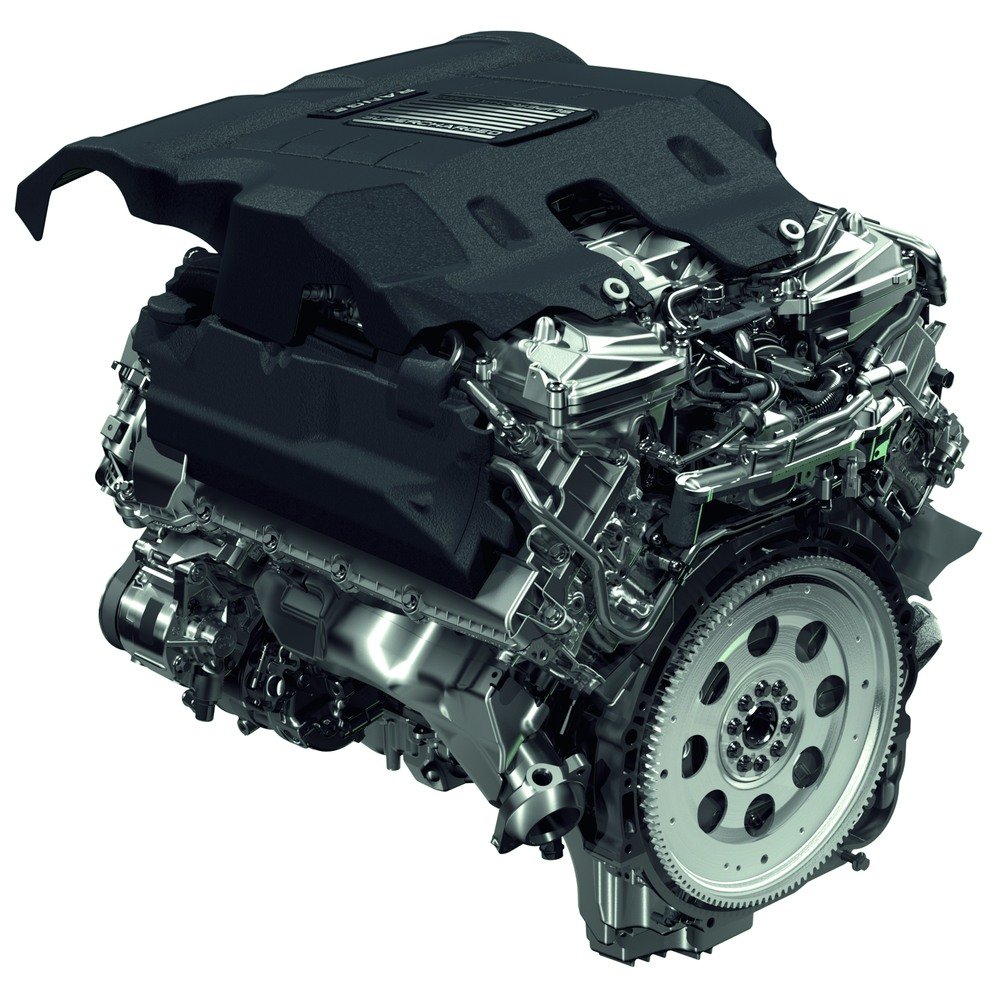
Specifications at a glance
Engine & construction
- Engine code
- 508PS (AJ133 supercharged)
- Displacement
- 5,000 cc nominal
- Block / head
- Aluminium / aluminium
- Bore × stroke
- 92.5 × 93.0 mm
- Compression
- 9.5:1
- Generation
- AJ-V8 Gen III
Air, fuel & valve gear
- Boost
- Belt-driven Roots-type TVS
- Charge cooling
- Water-cooled intercooler
- Fuel system
- Direct injection
- Valve gear
- DOHC · 32 valves · dual VCT
- Cam drive
- Timing chains
Power & torque
| Version | Horsepower | Torque · lb-ft |
|---|---|---|
| F-TYPE P450 | 444 hp | 428 |
| XF / XJ 470 hp | 470 hp | 424 |
| F-TYPE V8 S · 2014–2015 | 495 hp | 460 |
| XFR / XKR; early RR / Sport | 510 hp | 461 |
| Range Rover / Sport P525; Defender V8 | 518 hp | 461 |
| F-TYPE R / XFR-S / XKR-S; early SVR | 550 hp | 502 |
| F-PACE SVR · 2021–2024 | 550 hp | 516 |
| Range Rover SVAutobiography P565 | 557 hp | 516 |
| F-TYPE SVR / later R; Sport SVR | 575 hp | 516 |
Use the vehicle table for the correct model-year calibration. F-PACE SVR was advertised at 550 hp; the 2023 U.S. specification table gives 542 hp for P550. The naturally aspirated 508PN AJ133 has different specifications and is outside this supercharged guide.
Vehicles & model years
| Vehicle · version | Chassis · platform | Model years | hp | Torque · lb-ft |
|---|---|---|---|---|
| Jaguar XF · Supercharged | X250 | 2010–2015 | 470 | 424 |
| Jaguar XFR | X250 | 2010–2015 | 510 | 461 |
| Jaguar XFR-S | X250 | 2014–2015 | 550 | 502 |
| Jaguar XJ · Supercharged | X351 | 2011–2019 | 470 | 424 |
| Jaguar XJ · Supersport | X351 | 2011–2013 | 510 | 461 |
| Jaguar XJR | X351 | 2014–2017 | 550 | 502 |
| Jaguar XJR575 | X351 | 2018–2019 | 575 | 516 |
| Jaguar XKR / XKR-S | X150 | 2010–2015¹ | 510 / 550 | 461 / 502 |
| Jaguar F-TYPE · V8 S | X152 | 2014–2015 | 495 | 460 |
| Jaguar F-TYPE · R | X152 | 2015–2020 | 550 | 502 |
| Jaguar F-TYPE · SVR | X152 | 2017–2020 | 575 | 516 |
| Jaguar F-TYPE · R / R75 | X152 | 2021–2024 | 575 | 516 |
| Jaguar F-TYPE · P450 | X152 | 2022–2024 | 444 | 428 |
| Jaguar F-PACE · SVR | X761 · D7a | 2019–2020 | 550 | 502 |
| Jaguar F-PACE · SVR | X761 · D7a | 2021–2024 | 550² | 516 |
| Range Rover · Supercharged | L322 | 2010–2012 | 510 | 461 |
| Range Rover · Supercharged | L405 · D7u | 2013–2017 | 510 | 461 |
| Range Rover · P525 | L405 · D7u | 2018–2021 | 518 | 461 |
| Range Rover · SVAutobiography | L405 · D7u | 2016–2017 | 550 | 502 |
| Range Rover · SVAutobiography / P565 | L405 · D7u | 2018–2021 | 557 | 516 |
| Range Rover Sport · Supercharged | L320 | 2010–2013 | 510 | 461 |
| Range Rover Sport · Supercharged | L494 · D7u | 2014–2017 | 510 | 461 |
| Range Rover Sport · P525 | L494 · D7u | 2018–2022 | 518 | 461 |
| Range Rover Sport · SVR | L494 · D7u | 2015–2017 | 550 | 502 |
| Range Rover Sport · SVR | L494 · D7u | 2018–2022 | 575 | 516 |
| Defender · V8 | L663 · D7x | 2022–2024 | 518 | 461 |
| Range Rover Velar · SVAutobiography Dynamic | L560 · D7a | 2020 | 550 | 502 |
U.S. and Canadian engine-equipped versions; availability varies by trim and market. ¹ XKR-S is the 550 hp version, introduced for 2012; XKR is 510 hp. Slash-separated figures match in order. ² JLR advertised the 2021 F-PACE SVR at 550 hp; its 2023 U.S. specification table lists 542 hp under the P550 badge. The F-TYPE P450’s U.S. rating is 444 hp.
Engine controllers
| Controller | Processor | Applications |
|---|---|---|
| Denso P5.0SC | Renesas SH7059 | Legacy 5.0 Jaguar and Land Rover applications; some L494 listings also use Denso |
| Bosch MED17.8.31 | Infineon TC1797 | Listed on later supercharged V8 applications, including F-TYPE and newer SUV platforms |
The engine family spans more than one ECU supplier. Do not choose by displacement, badge or model year alone: read the controller label and diagnostic IDs. The vehicle’s hardware number, JLR part number and software calibration must agree before controller work.
Common issues & sensible maintenance
- Early timing-chain guides. JLR revised guide/tensioner parts on early 5.0 applications. Persistent chain rattle or cam-timing faults need diagnosis; revised components must be fitted as a matched repair set.
- Coolant pipes and overheating. Plastic pipe-joint leaks are documented on specified V8 applications. Check the engine valley, thermostat housing, pump and hoses; stop and investigate an overheat warning.
- Supercharger drive. Inspect belts, tensioners and coupling noise. Confirm whether a rattle comes from the drive, isolator or blower bearings before replacing the complete unit.
- Charge-cooler performance. Coolant circulation and heat-exchanger condition matter under sustained load. Heat-related power loss can come from the charge-cooling circuit rather than the engine itself.
- Misfires and oil leaks. Check plugs, coils, injector operation, intake leaks and crankcase ventilation. Trace oil leaks before low oil level compromises the timing drive or bearings.
- Servicing under load. Use the exact JLR oil approval for the VIN. Frequent short trips, towing and high temperatures warrant reviewing severe-use servicing, not relying on mileage alone.
Keep the basics right. Repair cooling leaks promptly and keep oil, spark plugs and drive belts current. A service bulletin applies to its listed VINs and build ranges; early timing-drive concerns should not be presented as equally common on every later AJ133.
References
Specifications vary by calibration and model year. Service bulletins document faults on identified applications; they do not establish a failure rate for every engine.