Volkswagen / Audi / Porsche · Gen 3 & Gen 3B
EA888 Gen 31.8T & 2.0T
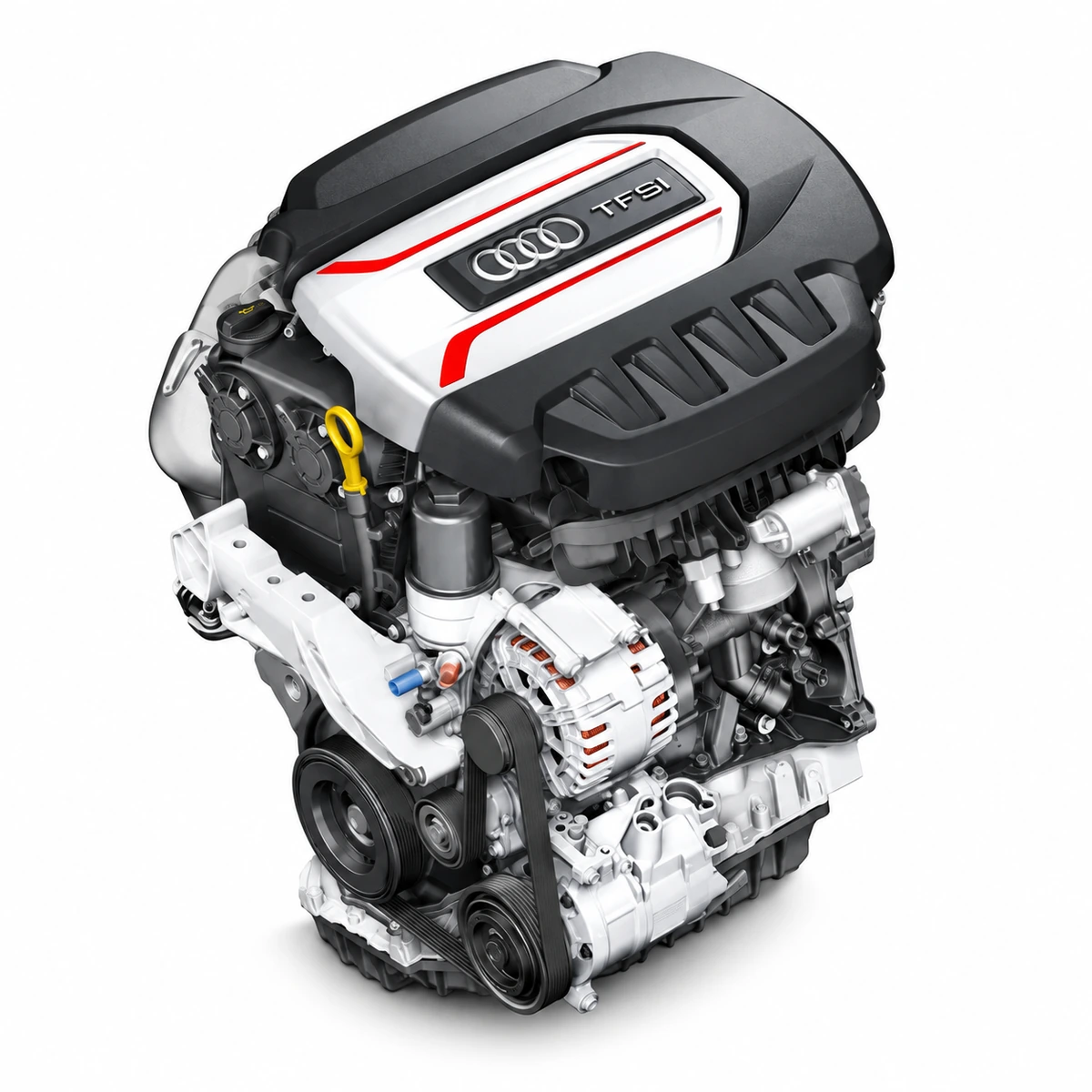
One engine family, several distinct personalities: an easygoing 1.8T Golf, a punchy GTI and a high-output Golf R. Gen 3 packages the exhaust manifold inside the cylinder head and uses an electric turbo wastegate. Gen 3B adds a shorter intake event and higher compression for efficient everyday driving.
Specifications
Core dimensions
- 1.8T displacement
- 1,798 cc
- 1.8T bore × stroke
- 82.5 × 84.1 mm
- 2.0T displacement
- 1,984 cc
- 2.0T bore × stroke
- 82.5 × 92.8 mm
Construction & timing
- Block / head
- Cast iron / aluminium
- Exhaust manifold
- Integrated into cylinder head
- Balance shafts
- Two · counter-rotating
- Valve timing / lift
- Varies by power class
Fuel & cooling
- Fuel injection
- Direct petrol injection
- Turbo control
- Electric wastegate actuator
- Thermal management
- Regulated pump / thermostat system
- Compression
- 9.6:1 common; higher on B-cycle
Factory output examples
- Golf 1.8T · 2015
- 170 hp / 200 lb-ft (automatic)
- GTI · 2019
- 228 hp / 258 lb-ft
- Golf R · 2015
- 292 hp / 280 lb-ft
- Tiguan B-cycle · 2018
- 184 hp / 221 lb-ft
B-cycle describes the combustion strategy, not a universal ECU or power rating. Fuel-system equipment, valve-lift hardware and oil approvals vary; North American engines should not automatically be assumed to have port injection.
Engine controllers
| Application group | Controller family |
|---|---|
| CPKA / CPRA · CPLA / CPPA | Continental Simos 12 |
| MQB 1.8T / 2.0T performance models | Continental Simos 18.x; later revisions vary |
| CYMC / DAYB longitudinal 2.0T | Continental Simos 18.4 |
| DDSA / DDSB · DGUA / DTEA CZRA / DBPA · B-cycle | Bosch MG1 family |
Later Simos revisions include 18.10. Match the controller hardware and software identification to the fitted engine; the platform or TSI badge alone is insufficient.
Vehicles by engine code
| Engine code | Vehicle | Model years | Chassis |
|---|---|---|---|
| CXBA / CXBB CNSA / CNSB | Volkswagen Golf 1.8T | 2015–2018 | Mk7 / 5G |
| CXBA / CXBB | Volkswagen Golf SportWagen 1.8T | 2015–2019* | BX |
| CXBB | Volkswagen Golf Alltrack | 2017–2019 | BX |
| CXCA / CXCB DKFA | Volkswagen Golf GTI | 2015–2021 | Mk7 / 5G |
| CYFB / DJJA DLRA | Volkswagen Golf R | 2015–2019 | 5G / BQ |
| CPKA / CPRA | Volkswagen Jetta 1.8T | 2014–2018 | Mk6 / 16 |
| CPLA / CPPA | Volkswagen Jetta GLI | 2013.5–2018 | Mk6 / 16 |
| DKFA / DXSA | Volkswagen Jetta GLI | 2019–2024 | Mk7 / BU |
| CPKA / CPRA | Volkswagen Beetle 1.8T | 2014–2017 | 5C |
| CPLA / CPPA | Volkswagen Beetle 2.0T | 2013.5–2017 | 5C |
| DDSA / DDSB | Volkswagen Beetle 2.0T · B-cycle | 2018–2019 | 5C |
| CPKA / CPRA | Volkswagen Passat 1.8T | 2014–2017 | NMS / A3 |
| DDSA / DDSB DTDA | Volkswagen Passat 2.0T · B-cycle | 2018–2022 | NMS / A3 |
| DGUA / DTEA | Volkswagen Tiguan · B-cycle | 2018–2024 | BW / BJ |
| DLRB | Volkswagen Arteon | 2019–2021 | 3H |
| DCGA / DTFA | Volkswagen Atlas 2.0T | 2018–2023 | CA |
| DCGA / DTFA | Volkswagen Atlas Cross Sport 2.0T | 2020–2023 | CMC |
| CNSB | Audi A3 1.8 TFSI | 2015–2016 | 8V |
| CNTC / DHHA | Audi A3 2.0 TFSI quattro | 2015–2020 | 8V |
| CZRA | Audi A3 2.0 TFSI FWD · B-cycle | 2017–2020 | 8V |
| CYFB / DJJA DLRA | Audi S3 | 2015–2020 | 8V |
| CYMC / DBPA | Audi A4 / allroad** | 2017–2020 | B9 / 8W |
| CYMC | Audi A5 / Sportback | 2018–2020 | B9 / F5 |
| CYNB | Audi A6 2.0 TFSI | 2016–2018 | C7 / 4G |
| DLHB | Audi A6 2.0 TFSI | 2019–2020 | C8 / 4A |
| DAYB / DJYA | Audi Q5 2.0 TFSI | 2018–2020 | FY |
| DHHA / DSNA | Audi Q3 45 TFSI | 2019–2025 | F3 |
| DSPA | Audi Q3 40 TFSI · B-cycle | 2021–2024 | F3 |
| CNTC / DHHA | Audi TT 2.0 TFSI | 2016–2023 | 8S / FV |
| CYFB / DLRA | Audi TTS | 2016–2023 | 8S / FV |
| CYNB | Porsche Macan 2.0T | 2017–2018 | 95B |
| DLHB | Porsche Macan 2.0T | 2019–2021 | 95B |
Selected U.S./Canadian applications; codes change within the listed years. *2019 SportWagen 1.8T is AWD. **DBPA denotes the A4 B-cycle version, not the allroad. Confirm the engine and chassis codes on the vehicle data label.
Common faults & maintenance
- Pump & thermostat leaks. Watch for falling coolant level or dried residue. Pressure-test to locate leaks and repair them before overheating occurs.
- PCV & oil use. A failing breather can cause rough running, oil leaks or consumption. Measure oil use and test the ventilation system before assuming internal wear.
- Intake deposits. Cold misfires and uneven idle have several causes. Inspect intake valves when diagnosis points to carbon; clean as needed.
- Turbo & wastegate. Underboost may come from an actuator, linkage or charge-air leak. Check boost control before replacing the turbo.
- Plugs, coils & injectors. Follow the model-specific plug interval and diagnose misfires promptly, particularly under load. Use the specified parts.
- Oil & service campaigns. Use the exact oil approval for the engine—VW 502 00, 504 00 and 508 00 are not universal substitutes. Check open campaigns by VIN.
Keep it healthy. Match maintenance to mileage, time and use. Frequent short trips and sustained heavy load deserve extra attention. Condition-based cleaning and early leak repairs help control costs; a fixed intake-cleaning interval cannot prevent every failure.
References & technical sources
| Topic | Reference |
|---|---|
| Design & specifications | Volkswagen SSP 820533 · Gen III enginesAudi 2017 A4 technical trainingVolkswagen 2014 Jetta factory reference |
| Vehicle applications | Volkswagen erWin model guideAudi erWin model guidePorsche Macan 2019–2021 engine reference |
| Output & service data | Volkswagen 2015 Golf R specificationsVolkswagen 2019 GLI specificationsAudi A3 B-cycle fluid specificationVolkswagen engine-capacity guide |
| Service campaigns | Volkswagen suction-jet-pump recall 20UF |
Factory ratings apply to the specified configuration and fuel. Service requirements vary by model and VIN; use the applicable owner’s manual and current repair information.